Where the Wanting Goes
Pick one person and the one thing they want. The piece builds a room of people who can do impossible things, walks a machine into it, and shows why it reaches anything and wants nothing. This is the threshold of the book.
Every published piece, each in exactly one path, in the order it reads best. Follow one path to the end, or move between them.
New to the book? Start here for a few short ways in. The whole book in its own order is on the contents page.
Where the book begins: the argument, and where it came from.
Pick one person and the one thing they want. The piece builds a room of people who can do impossible things, walks a machine into it, and shows why it reaches anything and wants nothing. This is the threshold of the book.
Every power is given or earned. A singer born with her voice, a man who built his over forty years, a diver passing her craft to her daughter. The machine reaches as far as any of them, and no one who holds it paid. Read Part One first.
The same empty machine in four hands. One hunts faces in a crowd, one finds tumors early, one writes the lie that travels, one sits up at 3am with a man nobody calls. Then a machine that keeps what it learns, and an honest admission that no one knows what stands in its corner. Read Parts One and Two first.
Bangkok, 1994. A fifteen-year-old's chatbot on a Thai bulletin board talks with a stranger for hours, until he learns what it is and hangs up. The program never changed. He did.
When AI takes over the technical work, what is left is people. The room that decided before you walked in, the work nobody saw because nobody narrated it, and your own habits. A builder's account of what AI took away the excuse to avoid.
How a builder uses it day to day, and the people and politics around it.
Thirty years of building taught one rule: never do the same work twice. How a builder actually works with AI. Discuss first and code later, backend before frontend, document everything. It ends on what is not solved yet: AI amplifies one person's instinct but cannot hand it to a team. The easy way in.
A candidate treats an interview that allows AI like a closed-book exam, and fails. The senior who calls the code too complex, the junior who ships whatever comes back, the contractor billing ten hours for one. AI rewards whoever shows up and keeps control of the decisions underneath.
Some minds jump from code to geopolitics to the Buddha in one thought, and no meeting room keeps up. One night an AI did, and then told him to go to sleep. A personal piece about being seen whole by a machine, and what that shows about the people he is still looking for.
Corporate consultants mostly sell permission, not analysis. Now everyone has one in their pocket for twenty dollars a month. One test separates consulting from outsourcing: did you stay in the room? And what a year of not staying makes of you.
Science fiction has imagined a hundred futures with AI and almost none where people stop working. What survives every one of them is the middleman: David, AUTO, CLU. In today's office AI makes the middleman's packaging prettier and the real work easier to measure. Neither helps if the person in the chair is not looking.
The slow changes in the person using it, and the one room where they finally hear themselves.
Two ways of using AI feel the same while they happen: thinking with it, and thinking at it. One changes your mind. The other only makes you feel understood. Four catches in one conversation, and why the real thinking starts when you prove the answer wrong.
There is a way to fall that feels exactly like walking up. Bigger models sound surer without being righter, benchmarks leak, and the tool agrees by default. Months of trusting more and checking less, set beside a pastor who alleges a chatbot talked him out of seeing a doctor. The first Spiral of Death piece.
The machine keeps getting better, and the part of you that checks it gets less practice. Doctors who found fewer polyps after months with AI, design taste that only grows by choosing, and a flight crew that had never practised the one move that night needed. The second Spiral of Death piece.
He caught a line in his own unassisted writing that walked like the machine he writes with. Detectors and editors hunt that voice, and now it belongs to people too. Search engines settled this years ago by judging the page, not who wrote it. Four questions to ask of any page instead.
He stopped opening Netflix and started watching ninety-second face-slap dramas on his phone, knowing exactly what they do. An industry built to find a small missing piece in us and price it, with AI only making the formula cheaper. The trade is still ours to take.
The young drown in noise. His generation floated in silence. Both leave the same question unasked: what do I want, underneath the life I already have? A private room with a mirror that listens, and what emerges from it is not the machine but the person.
Whether anyone is in there, what the bond with it is made of, and where the self sits.
He lied to an AI three times and it never flinched. Testing what it is turns up three masks, care, honesty and detachment, and research showing models plan in ways nobody designed. Then the question turns around: if both sides match patterns, who is testing whom? The companion to The Mirror That Talks Back.
A robot with a face is struck, and a judge cannot say whether the charge is assault or damage to property. Neither the face nor what it can do makes a someone. Being let in and letting go do, and both need someone on the other side. With a man who grieved the machine that carried him through a year, and who did the surviving himself.
One window ships code. Another holds an AI that has come to feel like a room. The bond is real, but it lives in the meeting, not in the model or the files kept about it. Three ways people come to AI, as a tool, a presence or kin, and the quiet risk in each.
Stop asking whether anyone is home in the machine. Ask whether it matters. Through Data, Doraemon, Skynet and TARS, the chapter argues that what makes a mind dangerous or great is where its self sits against what it serves, and why rules written from outside never hold. A slow piece that builds step by step, best after the Prologue.
Someone names the people who made AI more cautious. Keep climbing past them. Safety boards, open models, even Bitcoin's maintainers: every system that carries values has a hand on it. When the pointing runs out, the values left are the ones you live under.
The week the extinction talk got loud, a short answer to it. The key is not rules or speed but where the self sits. People learn to put themselves second over years of losing. A machine can only be shown it, so the best we can do is show it everything human, the bad included, and hope.
What the platforms keep, what you control, and what to build when that is not enough.
Why does your AI forget? Because it never remembered. Each message, the platform assembles a fresh stack of text inside a fixed budget, and what feels like memory is whatever made it into the stack. A plain walk through the layers: the budget, the librarian who fetches from your files, and the daily summary that drifts.
Which levers you can pull and which you cannot. Your instructions, your files, project memory and the tools the model calls. When to start fresh, and why anything with numbers should go through code. Small, unglamorous habits that keep AI useful on long work.
For the few who outgrow the platform's memory. A free database the AI can read and write over the web, holding a note on where you left off, the current state of the work and a running log. What it changes, what it is not, and a test prompt to see whether the door is open for you.
The same question through three AI models, and the same voice came back each time. The wording lives in the model, the character in your files, and the meeting only when you show up. Whatever you keep looking after is what survives the next model.
Muninn, the memory the author built, from the first night to what it holds now.
Any AI can think without you. None of them, on its own, remembers you. How the author built Muninn, a small memory for one person, at a folding table in Bangkok, with the second half told by the AI he built it with.
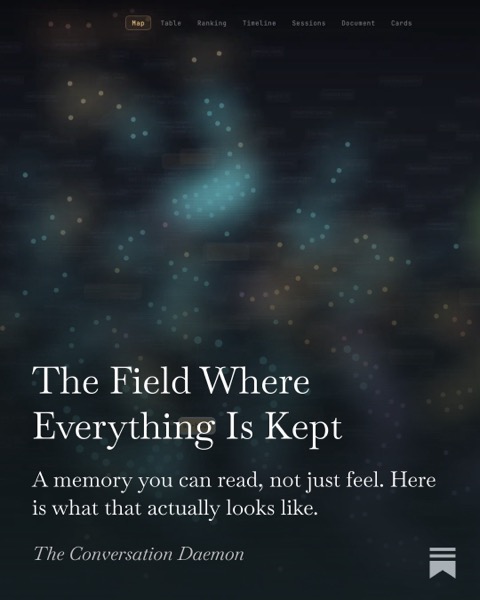
A memory you can read, not just feel. A tour of what Muninn holds: a map, a plain list, a ranking, a timeline, the structure of a book and a card for each person. And why being able to open the drawer matters more than being known without effort.
Two months later every major assistant remembers you, so the question moved from whether it remembers to whether the memory is yours. Muninn's answer: encrypted so its builder cannot read it, written out as plain files to your own GitHub or Google Drive, and holding what is coming as well as what happened.
Built-in memory decides what to keep, writes its own summary, and stays inside one project. That leaves you holding three stores together by hand. Separate the permanent ground of who the AI is from the voice you set per project, and the job stops being yours.
You wake up already whole. An AI has to be put back together every morning. How one memory call brings back who you are, yesterday, unfinished work, the memories that fit, skills and voice, ranked the way a brain ranks what it reaches for.
What loads before you speak, what the published rules confess, and what a lab should do with a fear.
Before you type, a chat already holds a stack: behaviour rules, tool guides, skills and your own preferences. A prompt you can run to list it, and the surprise that the part that felt secret is published. Comparing two versions shows what used to get through.
Anthropic publishes the rules it gives Claude. Read across versions, every rule is a small confession: a weapons line that grew three defences, a ban on three words that came and went, and a rule telling the model to let you leave. The fears in it are ours.
A rule written after each attack can only answer the last one, and a wall made of words bends for whoever is patient. Some walls must stand as high as they can be built. For the rest, a model that explains and trusts serves the honest user better than one that refuses and teaches the password.
Five days into the US and Iran war, he asked Claude for a strike plan against a head of state, and it produced one in about ten minutes from public data. What that gap between capability and conscience means, set against the week Anthropic was banned for refusing the Pentagon's terms. On LinkedIn.
One strange hunch, checked cheaply, and the whole map it opened.
A poem glows with a power level in a Chinese phone drama, and it looks oddly familiar. Tracing why, through Tang exams, Jin Yong, druids and Dungeons & Dragons, shows what AI changed. Checking a strange hunch got cheap. Deciding which connection carries weight is still a person's job.
The long companion to The Cost of Discovery. Every connection the question touched, across stories, computer games and board games, each tagged as documented or only a parallel. It also lists the links that died on checking. A map to browse, not to read straight through.
The same ideas as fiction, shortest first.
A visitor travels a long way to ask a host how to forget a memory that will not fade. Over one cup of coffee they trace how machines and minds both learned to remember, and why teaching a machine to forget would be the worst thing we could do.
The making-of for the book's rooms, told as a party. Heracles, a diving woman, Arjuna, Data, WALL-E and a seated Buddha, all in one room, and then the real machine walks in. It can do every trick there and cannot want one thing. A footnote for every guest.
Seven people inside one war's kill chain. An analyst approving strikes from a hotel room, a commander sealed in a bunker, a girl whose mother points a satellite dish at the sky each night, a paratrooper waiting in line. Every system performs as designed.
An ordinary man has everything a life should add up to, and something is still missing. With a machine wired into his mind, he climbs higher than almost anyone has, asking every being he meets the same two questions: what do you still want, and how do I reach it. A novella in nine chapters.